
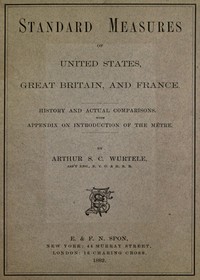
Standard Measures of United States, Great Britain and France by Wurtele
Let's be clear from the start: Arthur Wurtele's 1866 reference work, 'Standard Measures of United States, Great Britain and France,' is not a novel. You won't find a sweeping plot or deep character arcs. Instead, think of it as the ultimate guidebook for a very specific kind of international traveler—the kind dealing in goods, science, or law in the mid-1800s.
The Story
The 'story' is one of practical problem-solving. In the 1860s, global trade and scientific collaboration were accelerating, but there was no common measurement language. An American merchant buying French silk, a British engineer reviewing American bridge plans, or a French chemist replicating a British experiment all faced a wall of confusing conversions. Wurtele, recognizing this friction, compiled a meticulous manual. He laid out the official standards for weights, measures, and currency for these three nations side-by-side. He provided conversion factors and explained the legal definitions, like the exact length of the British Imperial yard or the French meter. The narrative tension, if you will, comes from seeing just how many different ways there were to measure the same thing, and the sheer effort required to make them all talk to each other.
Why You Should Read It
What makes this old manual compelling is its context. Reading it, you feel the growing pains of globalization. This book was a tool for building a more connected world. It’s surprisingly human. Behind every table comparing bushels to hectoliters, you can imagine the frustrated ship captains and the meticulous customs officers trying to avoid costly errors. It turns abstract history into something tangible. You start to appreciate the metric system not as a boring school lesson, but as a revolutionary idea that solved a real, messy problem. Wurtele’s work is a quiet witness to that moment just before a major shift, making the past feel immediate and relevant.
Final Verdict
This is a niche read, but a rewarding one. It's perfect for history buffs who love the 'how did they manage that?' details of daily life, or for anyone with a curiosity about science, trade, and the hidden frameworks of society. If you enjoy books like Simon Winchester's 'The Perfectionists' or enjoy falling down Wikipedia rabbit holes about obscure standards, you'll find a kindred spirit in Wurtele. It's not a cover-to-cover read, but a fascinating artifact to dip into. You'll come away with a new appreciation for the rulers in your desk drawer and the fact that a kilogram in Paris is the same as a kilogram in Tokyo—something that was absolutely not a given in 1866.
This work has been identified as being free of known copyright restrictions. Access is open to everyone around the world.
Sarah Clark
1 year agoCompatible with my e-reader, thanks.
Ashley Torres
1 year agoAfter finishing this book, it manages to explain difficult concepts in plain English. A true masterpiece.
Susan Gonzalez
1 year agoBeautifully written.




Aiden Walker
6 days agoI started reading out of curiosity and the storytelling feels authentic and emotionally grounded. Worth every second.